
WashCOG’s social media sampling
WashCOG is active on a number of social media outlets, including Instagram at waopengov, Threads at @waopengov, X (Twitter) at @WashingtonCOG and Facebook at https://www.facebook.com/washingtoncog. Below are a few of our recent and most popular Facebook posts.
Jan. 3, 2026 -
A bill filed before the Washington state Legislature convenes would give public school districts the ability to charge more for “overly burdensome” records requests and to seek court orders blocking them.
Senate Bill 5920 calls itself an act “providing protections for school districts against burdensome public records requests.” It was sponsored by state Sens. Lisa Wellman, D-41, and T’wina Nobles, D-28.
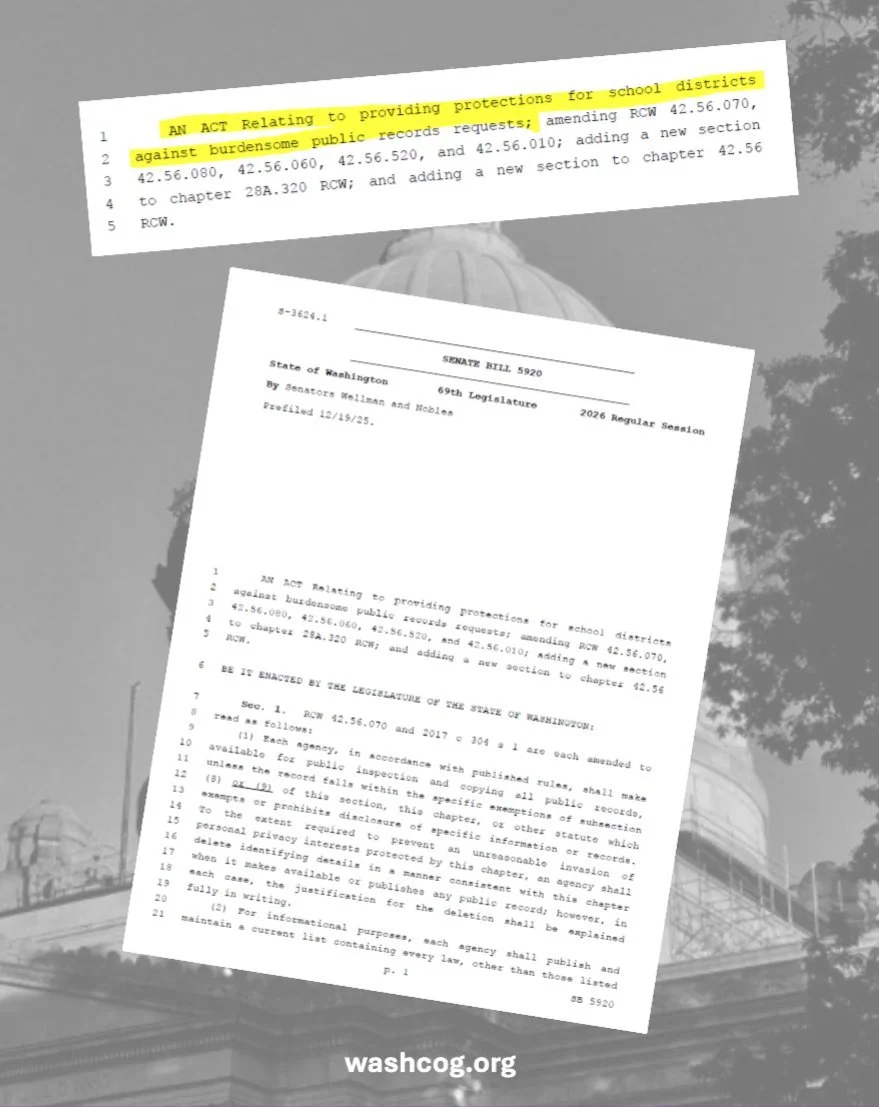
The legislative session begins Jan. 12. SB 5920 would amend the state Public Records Act. As written, the draft legislation would:
• Let school districts impose additional charges “for requests that are overly burdensome,” as determined by such things as the amount of information sought and the level of staff time needed to retrieve it. Requesters would have to accept the surcharges before districts process their requests. Those who can prove financial hardship could ask districts to waive the surcharges.
• Give districts more time to respond to out-of-state requesters.
• Create a pathway for districts to ask courts to deny requests “that are vague, overly broad, or unreasonable in scope.” School officials could seek protective court orders against requests filed “with the intent to substantially interrupt the performance of a government function.” Districts would have to give requesters the opportunity to clarify or narrow their requests before taking the matter to court. If requesters do not respond within 30 days, districts could proceed with seeking a court order.
• Require everyone to submit requests to the districts’ designated public records officers. Districts must provide instructions on how to ask for records through their websites.
• Exempt some categories of requesters from these requirements. They are the “news media, parents or guardians of students enrolled in the district, or district employees.”
Where to start? We will have more to say as the session unfolds.
The draft bill is posted on the state Legislature's website here.
Jan. 2, 2026 -
A lot is going on in January. For starters:
- The state Legislature convenes Jan. 12. Every session we see several bills that would either carve new holes in the Public Records Act or raise new hurdles for requesters. Many of those bills succeed. The session has yet to start, and already lawmakers have proposed four bills that would create new exemptions or address "burdensome" requests. More such bills are on the way. We have lots of practice playing defense, and we'll need it this year, with your help.
- Oral arguments for two important public records cases are scheduled Jan. 29 at the state Court of Appeals in Tacoma. One case challenges the state Legislature's claim that it has a secrecy "privilege" to withhold records from the public. (We're one of the appellants.) The other case challenges a lower court's dismissal of a lawsuit over the state's automatic deletion of workplace text messages.
- Watch for information about our annual Sunshine Breakfast, scheduled for March 13, 2026 in Bellevue. Our breakfast is in conjunction with Sunshine Week, the annual celebration of open government. that aligns with James Madison's birthday.
Dec. 31, 2025 -
The Washington state Court of Appeals in Seattle this month accepted our amicus brief in a case that challenged what is considered an open public meeting.
On the morning of April 25, 2024, Burien Mayor Kevin Schilling announced a press conference later that day to talk about a conflict with the King County Sheriff’s Office over the city’s homelessness policy.
Schilling was joined by three of his colleagues on the seven-member Burien City Council, which constituted a quorum.
Arthur West of Olympia sued the next day, contending that the press conference violated the notice requirements under the state’s Open Public Meetings Act. State case law is silent on whether a public agency’s press conference can violate the OPMA.
A King County Superior Court judge ruled for the city and concluded that West’s lawsuit was frivolous and without reasonable cause, resulting in a $48,804 sanction against the plaintiff.
West appealed. In court filings, he argues that the trial court mistakenly concluded that the Burien City Council’s April 25 gathering was not a public meeting. West also contends that the sanction against him was unwarranted.
WashCOG joined the case with an amicus brief. We are especially troubled by the nearly $50,000 sanction against a citizen plaintiff.
Our attorneys argue that West’s lawsuit raised new legal issues and was neither frivolous nor without reasonable cause under state statutes.
WashCOG lawyers Judy Endejan and Joan Mell wrote, “This erroneous ruling below must be corrected, or citizens will be deterred from bringing necessary OPMA enforcement actions in the future.”
They continued, “It is hard enough for citizens to hold public officials accountable for OPMA violations without fear of unwarranted trial court punishment.”
We posted our amicus brief on our DocumentCloud.
The case before the state Court of Appeals, Division I, is Arthur West v. Burien City Council, et al., No. 876864.
December 20, 2025 -
People in Washington state are filing public records requests daily, and lately we have been struck by some of their work.
Among the examples we know about:
• On the Olympic Peninsula, Sarah Huling asked Clallam County for records pertaining to its policies and programs addressing substance abuse. More specifically, Huling wondered whether the county’s programs were actually meeting desired outcomes. The records documented a great deal of activity, but with little clarity – that’s an understatement -- about whether substance abuse was declining because of the county’s actions. And here’s the kicker: Huling is a public official. She is a medical technologist and an elected Forks Community Hospital commissioner.
• Lewis County is home to confessed public records nerd Brittany Voie, who dived head-first into the many issues surrounding Flock Safety cameras. Local governments in our state have installed the license-plate readers next to their streets and intersections. In recent weeks Voie has filed a series of public records requests for Flock data and spoken with local police about how they use the technology. She frequently posts the outcomes of her requests and meetings on her Brittany Voie Facebook page. When a reader recently asked us for advice requesting Flock data, we referred him to Voie. “She’s the expert,” we said.
• It’s worth repeating the story of Jayme Peloli, a member of the Wilkeson Town Council in Pierce County. Wilkeson is an old logging and mining town that sits astride a highway to the northwest entrances of Mount Rainier National Park. Or at least it used to. In April the state abruptly closed its 104-year-old bridge over the Carbon River gorge because of structural weakness, blocking public access to the upper valley and the park. Peloli wanted to know how the state could manage a bridge to failure. So she filed public records requests, including for 20 years of bridge inspection reports. The documents showed inspectors for years had documented the span’s deterioration, yet the bridge was repeatedly passed over for maintenance and repairs. Peloli has since enlisted the help of state legislators for the upcoming session. Later this month she will be sworn into office – as mayor.
These stories are emphatic counterpoints to the narrative we often hear in Olympia – that too many abusive requesters are interfering with the government’s work and wasting taxpayer dollars. Therefore, the Public Records Act must be curtailed.
The prevailing reality is that requesters are trying to understand what’s going on and evaluate their government’s performance. That’s why the Public Records Act must be protected.
You can find Peloli's report on the bridge inspections posted on Facebook.
Dec, 19, 2025 -
The never-ending debate over Washington state’s Public Records Act often comes down to money.
“Does it cost too much?” is commonly posed by local governments. Requesters frequently reply, “Are agencies spending enough?”
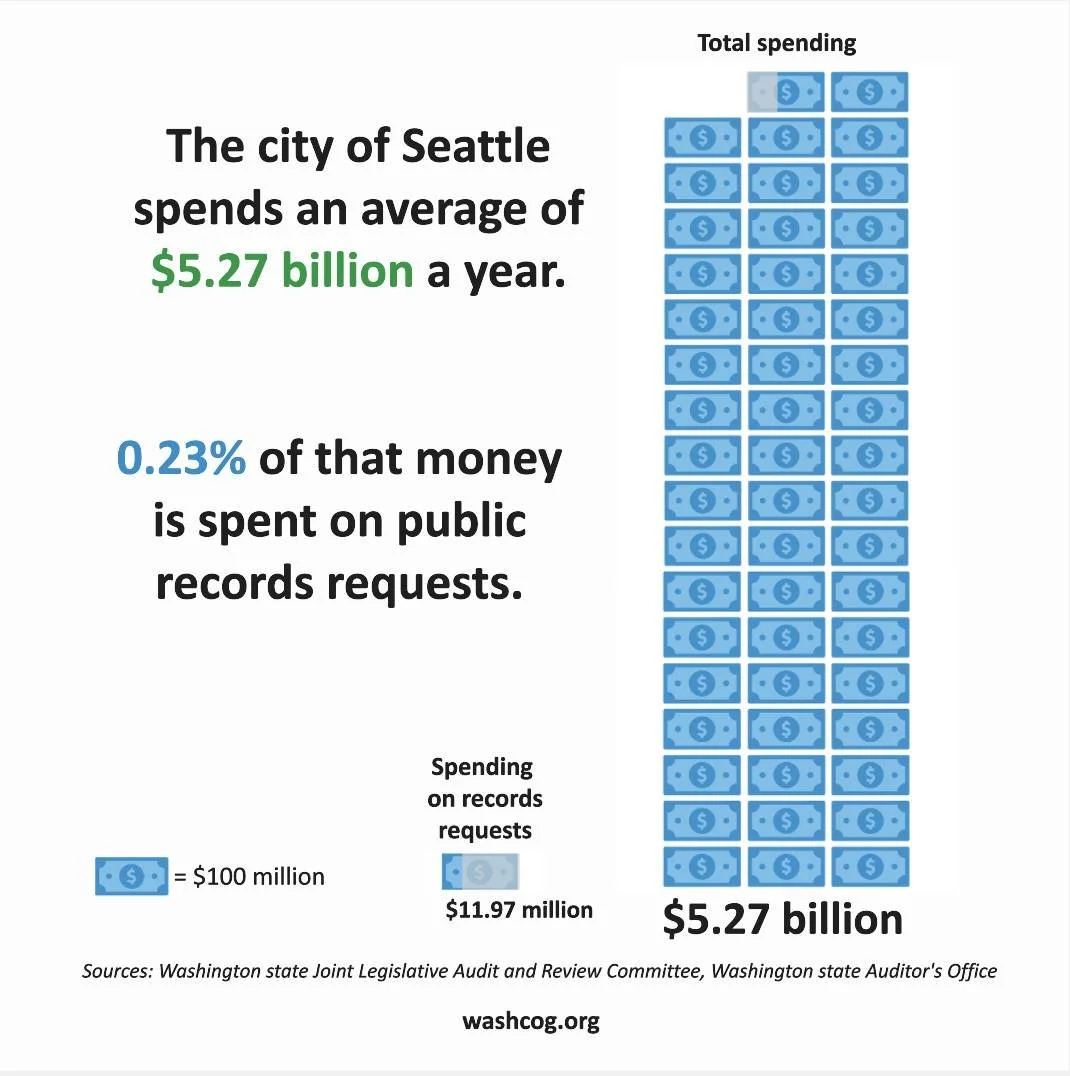
We looked at the five Washington state cities that spent the most money fulfilling public records requests and made a somewhat expected discovery: Their spending on records requests amounted to less than 1% of total outlays.
Even the cities that spent the most on records requests aren’t going broke because of it. Far from it.
We crunched the numbers compiled by the state Auditor’s Office and the Joint Legislative Audit and Review Committee. The five cities with the highest average spending on records requests over three years were, in order, Seattle, Vancouver, Tacoma, Spokane and Renton.
On average, those five cities spent between 0.12% and 0.55% of their total outlays on records requests during the three years that ended in 2024.
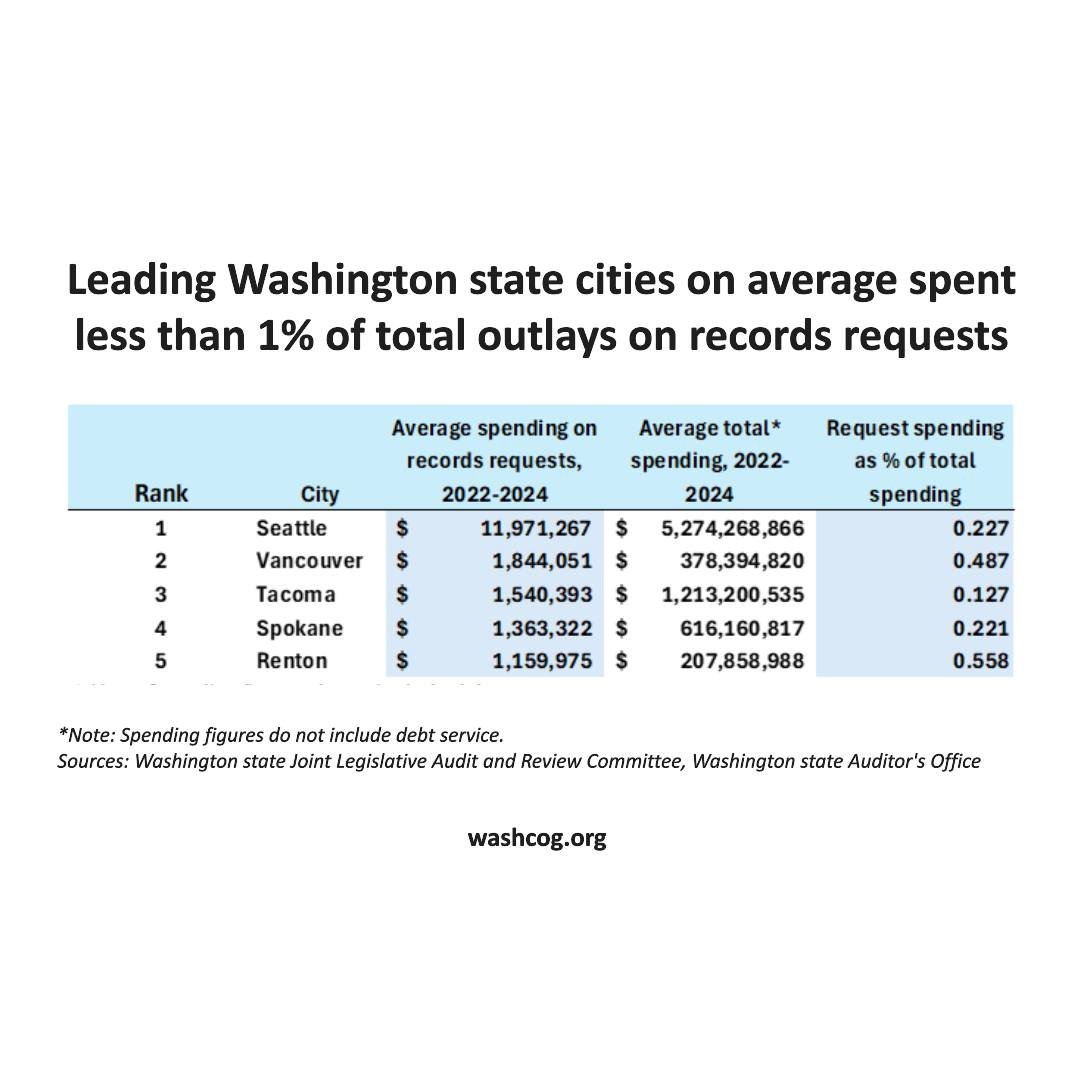
Those percentages, all less than 1%, are contrary to a narrative we often hear in Olympia: Records request expenses are pushing cities to the breaking point. It’s not clear how 0.55% demolishes municipal bank accounts.
The public records data gathered by the Joint Legislative Audit and Review Committee, or JLARC, takes on new significance because a powerful municipal group is questioning why the committee compiles it.
The Association of Washington Cities seems especially interested in discontinuing the financial reporting – the very data we used to determine how much cities spent on records requests relative to their total outlays.
Perhaps the information and what it shows is inconvenient for cities. We contend the data is invaluable. It helps all of us see the real picture and cut through the rhetoric and selective anecdotes that so often cloud policy debates over public records in Olympia.
Tell your legislators to reject efforts to limit or end JLARC’s data-gathering program.