
State review of chat deletions policy has taken place — quietly

Analysis by Jamie Nixon
In February 2025, one month into his administration, Gov. Bob Ferguson did something former Gov. Jay Inslee never did: He suspended Washington state’s automatic deletion of instant-message chats such as Microsoft Teams.
That was good.
More than a year later, however, the public still has no idea what is happening on this issue behind the very closed doors the governor is using to hide his administration’s review of the issue.
Ferguson said his administration was suspending Teams auto-deletion “until my team has completed a thorough six-month evaluation.” That statement came after a $225,000 settlement involving the Department of Children, Youth and Families (DCYF) and allegations that public records were destroyed under the state’s seven-day Teams deletion policy.
The Seattle Times reported that Washington Technology Solutions (WaTech) first implemented the seven-day policy agencywide in 2021, and that Ferguson’s office said he was directing WaTech and other state agencies to suspend automatic deletion while the six-month review occurred.
That six-month clock should have run out in August 2025.
It is now summer 2026. So where is the review?
This question requires an answer because records belong to the people, not the government. The Public Records Act (PRA) does not exist so that agencies can quietly negotiate in private and allow the proof of what they did to disappear into the Microsoft ether.
The PRA exists because the public is supposed to be in the room, or at least able to look through the window.
The policy came from somewhere
The seven-day Teams deletion policy was not a rogue setting flipped by one confused IT staffer.
It was a statewide executive-branch practice, adopted by or applied to many agencies under the Inslee administration through the Microsoft 365 shared tenant managed by WaTech.
By the time Ferguson became governor, the policy had been in practice for more than four years, generating serious concerns from journalists, lawyers, requesters, and state employees.
The legal risks were not mysterious. In a June 2021 Attorney General’s Office advice memorandum to the Department of Ecology, an assistant attorney general warned that Office 365 and Teams created public records risks because data could be stored in “various different locations,” some locations might not be readily searchable, and Ecology could not implement effective litigation holds for Teams chat conversations.
The memo warned that this could increase the risk of destroying records responsive to public records requests or litigation.
The Attorney General’s Office warned agencies in 2021 that Teams presented real public records and litigation-hold risks. Despite these warnings, most of the state’s executive branch agencies moved forward with the seven-day auto-deletion regime.
Then, when the policy was challenged, Ferguson’s Attorney General’s Office defended agencies in litigation.
The Seattle Times reported that Ferguson’s office defended DCYF in the case that led to a $225,000 settlement, while the plaintiffs alleged DCYF deleted messages after a records request and had “no reasonable explanation” for noncompliance.
The Attorney General’s Office denied those allegations, but the state had to pay nearly a quarter of a million dollars.
To this day, Attorney General Nick Brown’s office is defending the state’s claimed right to automatically destroy public records before they are requested, even as my lawsuit asks the courts to enjoin that practice.
It is clear the Attorney General’s Office promotes early destruction with the policy choice to defend agencies in this way… and it is a policy choice.
In Washington, the attorney general is empowered to end litigation when they see fit. They do not need their client (the agencies) to support the settling of litigation.
All this leaves Ferguson in a bit of a pickle. When he was attorney general, he defended the state’s position. As governor, he suspended the policy. And now, he has not publicly explained what his own review found.
An unacceptable theory
Even after the suspension, the state’s internal messaging continued to lean on the same flawed premise: Teams chats are expected to be “transitory.”
WaTech draft communications in February 2025 said the expectation “has been, and remains” that Teams messages are “limited to transitory records” and therefore not subject to retention, while instructing employees to preserve records that should be retained under agency schedules.
That sounds tidy in a memo. It falls apart in the real world.
In records-management terms, “transitory” generally refers to communications with only short-term value that do not document agency decisions, actions, transactions, or other public business requiring retention.
The problem is that the value of a message is often not obvious to the person sending it at the moment it is sent. One employee may see a message as routine. A requester, journalist, investigator, litigant, whistleblower, or member of the public may later see that same message as critical context.
A message saying, “I’ll be late to the meeting,” may not have any long-term business value to the sender. However, if the timing of that meeting later matters, that same message may become evidence. A chat about lunch may reveal who was meeting with whom at a particular time. A casual note about copies, drafts, or who received a document may later explain how a decision was made or how information moved through an agency.
Records do not become transitory because they live in Teams. Records are judged by their content and function, not by the app where a state employee happened to type them.
While this controversy centers on Teams, the principle is much bigger than one Microsoft product. State agencies also use Slack, Zoom chats, text messages, internal messaging tools, and other collaboration platforms. New tools will come along. The law cannot change every time government buys a new app. Public records must be preserved based on what they say and what public function they serve, not where the message happened to be created.
I wonder if the governor is aware that I am in possession of records, from his own office, showing his staff continuing to engage in non-“transitory” communications over Teams chat just DAYS after Ferguson announced the suspension of the policy and reiterating to all state staff that those Teams chats are to be “limited to transitory records.”
He can’t even get his own staff to comply with his order.
Even WaTech employees seemed to understand the problem was more nuanced than the public-facing talking points. In one February 2025 internal exchange, Jason Beers of WaTech wrote that the last paragraph of a draft message was “only 50% accurate,” explaining that one-to-one and one-to-many chats “should be transitory in nature,” while channel chats were “not limited to transitory content.”
That is the whole mess in one email: The state wants platform-based simplicity, but the law demands content-based analysis.
An unfulfilled promise
On Feb. 18, 2025, Ferguson’s auto-deletion suspension was framed as temporary. WaTech communications said the auto-deletion feature would stop for six months “to allow for an evaluation.”
The attorney general sent similar language to employees: The seven-day deletion setting would disappear by the end of the week and remain suspended for six months. Teams messages would only be deleted if users deleted them manually.
The public had reason to expect a decision around August 2025. Perhaps even an explanation.
Now 16 months later, the public remains in the dark about what is happening with our public records.
What public records show
Public records indicate the review was not stalled for lack of activity. By spring 2025, the Governor’s Office, Office of Financial Management, WaTech, and agency deputies had built a structured process around Teams chat retention.
OFM records show a kickoff meeting occurred in May 2025, followed by distribution of a WaTech presentation titled “Teams 1vN Chat Retention Options.”
The presentation laid out four options:
No retention, no automatic deletion
Retain only
Retain and delete… identified as the configuration “in place today”
Delete only
The deck also showed the scale of the problem. One chart titled “Enterprise Shared Tenant Chat Accumulation” displayed Teams chat growth from February through May 2025, with total chats rising into the hundreds of millions.
This was not a marginal records issue. This was a statewide records system generating and then within seven days deleting millions upon millions of messages inside a platform the state knew was legally risky.
The workaround problem
One WaTech handout, “Configuring Teams Chats for Visibility & Discoverability,” is especially revealing.
It states that agencies would follow retention schedules and processes shared by the Secretary of State’s Office, then lists methods agencies had used for retention: screenshots, cut-and-paste into Word or Outlook, “Share with Outlook,” and “Print Screen.”
Those are not serious enterprise records-management solutions.
Screenshots and copy/paste methods strip context, omit metadata, depend on individual employee judgment and create inconsistent records. They are not a substitute for system-level retention, litigation holds, searchability and production.
DOC’s own Teams guidance illustrates the weakness of that approach. It tells employees that if they receive a chat with non-transitory content, they should ask the sender to move future communications to email or another secure platform so records can be retained. That puts the burden on individual employees to identify retention value in real time, correct other employees’ behavior, and manually move records out of the platform. That is not a reliable public records system.
The people’s records should not depend on whether someone remembered to “Print Screen” before the chat vanished. With the tech available today that should not be how this works.
The drafting begins
The review appears to have moved beyond basic information gathering by June 2025.
On June 30, OFM staff wrote that they had asked for help with “the draft recommendation work for the teams workgroup,” and that once they had a basic draft, they could turn it over for review.
That same day, another OFM email drafted a message to the Teams workgroup explaining that the group would take what it had “collectively worked through” and meet with the Attorney General’s Office.
The stated purpose was for AGO feedback to identify “blind spots” and areas needing deeper review. The email also referenced “the actual briefing we’re working on.”
That is notable.
By June 2025, this was not an abstract evaluation. They were working on draft recommendations, preparing a briefing, and consulting the Attorney General’s Office.
The process advanced again in August.
OFM staff sent AGO attorneys a “CONFIDENTIAL - DRAFT Briefing for Friday” and described it as “the DRAFT briefing our group has been working on for Governor Ferguson’s consideration.” It asked AGO attorneys to review and provide advice or feedback.
Later records show OFM and governor’s staff discussing updates based on an AGO meeting. The small group working on the materials had met and discussed “potential updates to the briefing paper for Governor Ferguson based on last Friday’s meeting with the AGO.” One of them had access to the draft and was expected to review and comment.
By August 2025, the Governor’s Office was not empty-handed. There was a draft briefing for Ferguson that had AGO review. There were expected edits, and a document was moving through the system.
Fall progress
The strongest records come in October 2025.
On Oct. 29, an email was sent titled “Next Steps for Teams.” The author wrote that they had just had a meeting and needed “to make some edits and updates to get this over the line.”
That is not preliminary language. This sounds like a process approaching completion.
Other OFM records from October referenced an in-person meeting to work through “final recommendations around Teams” and noted that they were trying to get the issue “wrapped up as soon as possible.”
The public record now shows a review process that appears to have reached the recommendation stage by fall 2025.
Then came silence
According to the available timeline, Shauna Sowersby asked the governor about the status of this process during a February 2026 press conference. The Governor’s Office response was essentially that they did not have anything new on it yet.
However, the Governor’s Office had records showing:
A Teams workgroup had been formed.
WaTech had presented retention options.
The Statewide Deputies had been briefed.
Draft recommendation work was underway by June.
AGO review occurred by August.
A draft briefing existed for Ferguson’s consideration.
By October, staff were referring to a working draft and trying to “get this over the line.”
So why was the public told nothing?
Reducing months of documented work to “nothing new” might be politically convenient. But it is not transparent.
Closed-door haggling
The deeper problem is not just delay. It is process.
Retention of public records is not an internal housekeeping matter. It determines matters of great public interest, including:
what the public can know about its government
whether journalists can reconstruct decisions
whether watchdogs can identify misconduct
whether litigants can discover evidence
The very words in the preamble to the Public Records Act say “The people, in delegating authority, do not give their public servants the right to decide what is good for the people to know and what is not good for them to know.”
A policy about destroying the people’s records should not be negotiated quietly by the same government institutions that benefited from the deletion policy in the first place.
The executive branch may need technical expertise, legal analysis, and/or budget input. But it definitely needs public-interest/stakeholder input.
Journalists, requesters, records officers, archivists, civil-rights advocates, litigants, whistleblowers, and members of the public all have a stake in whether state business conducted through Teams, Slack, text messages, Zoom chats, and future communication tools is preserved, searchable, and producible.
The state has spent years insisting employees should not use Teams for substantive public business, but records show state employees did anyway. The answer cannot be: “Well, we told them not to, so if records disappeared, that’s awkward but spiritually compliant.”
That is not how the PRA works.
The unanswered questions
The governor should answer these questions publicly:
Has the six-month review been completed?
If not, why not?
Were recommendations prepared for Ferguson in 2025?
Was the “working draft for the Teams recommendation” finalized?
What was in the August 2025 draft briefing for Ferguson?
What did the Attorney General’s Office recommend?
Why was the public not told that recommendations appeared to be nearing completion in October 2025?
Has the governor consulted WashCOG or any public-interest transparency organization?
Will the governor release a draft policy for public comment before making a final decision?
Why did the governor, as AG defend the indefensible policy of auto-deletions of the people’s records which the Attorney General's own Model Rules on Public Disclosure highly discourages?
Why does new Attorney General Nick Brown continue to defend it?
Will that policy also apply across modern communication platforms, including Teams, Slack, text messages, Zoom chats, and whatever tool agencies adopt next?
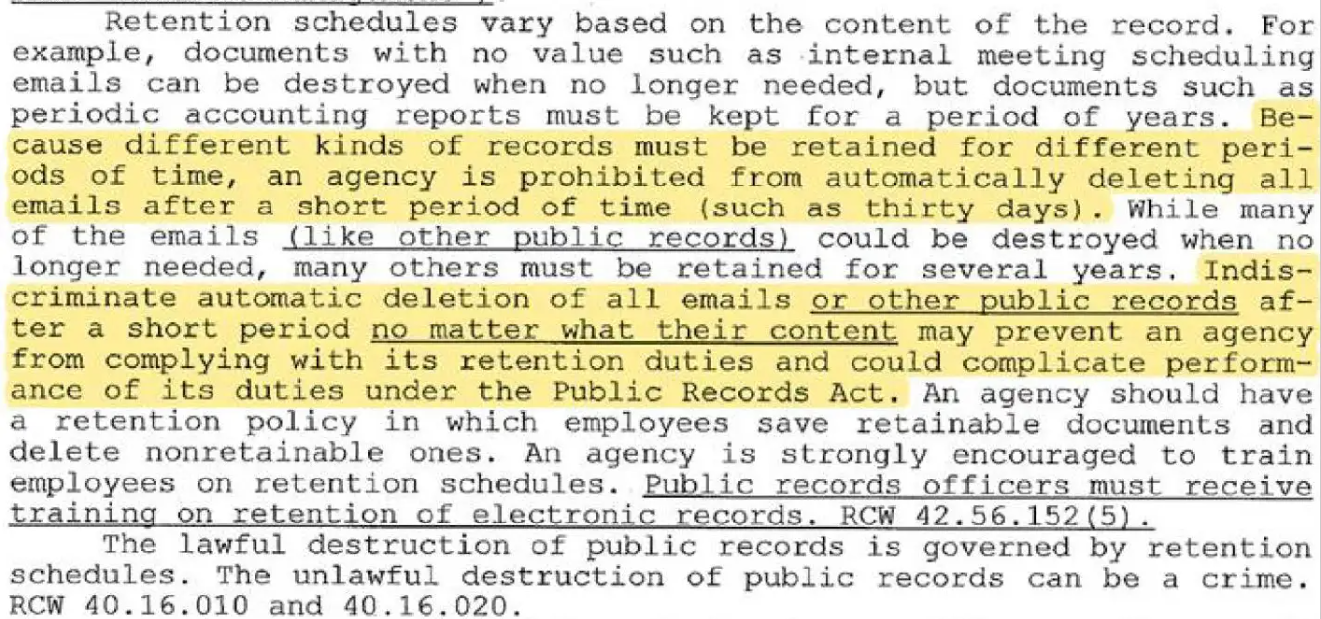
Screen cap of AG’s model rules aa of 2025 (the AG’s office is considering revisions)
And most importantly:
Will Washington finally adopt a records policy based on content and legal function… not the location where a record happens to live?
The bottom line
Ferguson was right to suspend the seven-day Teams auto-deletion policy. However, suspending a bad policy is not the same as fixing it.
The records now available show that his administration worked on recommendations throughout 2025 and appeared close to finalizing them in the fall. Ferguson never told the public what happened. The six-month review has become an open-ended silence, and the state’s own records show the issue is too important to be left behind closed doors.
The people of Washington do not need another quiet internal process. They need a public answer, the recommendations, and they demand and are owed the records. They need a governor willing to say clearly that public records are not disposable just because they were created in Teams or any other instant messaging platform.
The rule should be simple: If a communication documents public business, it must be preserved according to its content and function. The government should never be allowed to make records disappear simply by moving conversations into a tool designed for speed and informality.
The public’s records belong to the public… not to WaTech, not to OFM, not to the attorney general, and not to the governor.
Public records definitely do not belong to an auto-delete setting hiding behind the word “transitory.”
The Washington State Supreme Court denied Jamie Nixon’s appeal challenging the state’s Teams and other messaging retention practices on June 30, 2026.