
Investigation shows overtime raises pensions (and taxpayer costs) for police, firefighters
KEY PROFILE: Seattle Times reporter identifies Seattle’s ‘pension padding’ practice
This is one in a series of profiles of a person honored by the Washington Coalition for Open Government for their effective use of Washington’s access laws in ways that benefit the community.
By Colette Weeks, WashCOG Executive Director
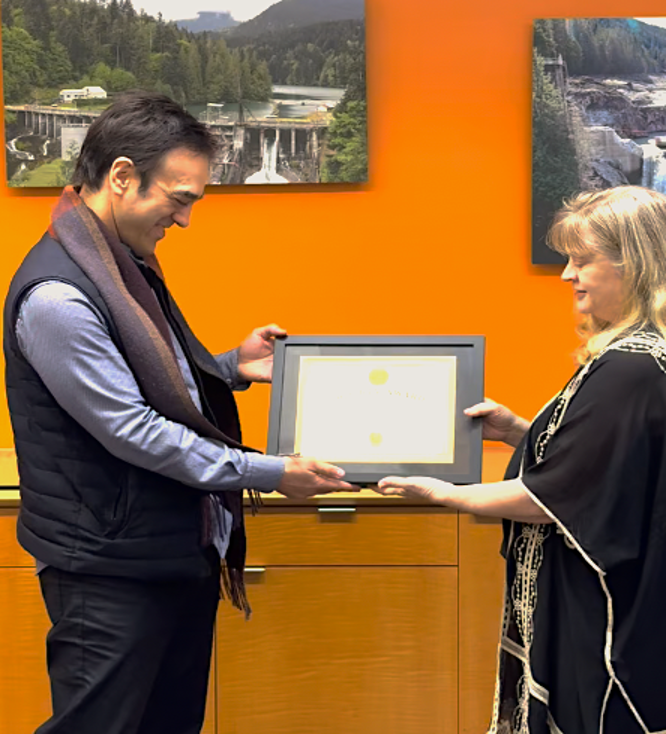
Manuel Villa is presented a Key Award on May 21, 2026, by Colette Weeks, executive director of the Washington Coalition for Open Government. (Photo by Mike Fancher)
It happened the way these things sometimes do. A news story is published, and the tips start rolling in. Those tips draw a path to a new story – a bigger story. But this one isn’t as easy to crack.
Seattle Times reporter Manuel Villa had worked with a former colleague on a story in 2021 about a police officer accumulating massive amounts of overtime.
The tips that followed pointed to a practice known as “spiking,” where overtime is used in the years before retirement to pad pensions. In Seattle, this was happening in the police and fire departments, which are part of a state-run pension fund.
“But we didn’t really have the data to prove it, and it took us some time,” Villa said.
It took time to get 20 years’ worth of data from various locations because the state-run pension fund didn’t track overtime hours. It took time to calculate and analyze the data gathered because the state had not done so.
Villa figured it out on his own, and with help from the investigative team, the story published in April 2025. The data showed that police officers and firefighters in Seattle added millions to their pensions through “spiking.” By 2044, the state will have paid $158 million more to those Seattle retirees than it would without including overtime.
Villa was presented with a Key Award at the Seattle Times office on May 21 in connection with the work he did to shine light on the pension situation. It’s an honor given by the Washington Coalition for Open Government to people who have done something notable in service of government transparency and public access. Some other recent winners included a mayor, a lawyer, a few parents and several college students, among others. They were on different missions, but like Villa, they all took steps to invoke the people’s right to know.
Knowledge is power, but change requires reaction from an informed public.
Other states have ended the practice of including overtime in pension calculations, according to The Seattle Times report. But not Washington. Officials here have known for years that the overtime situation is costly but have done nothing to change it.
Villa’s story notes that legislators attempted to remove overtime hours from the pension plan over 10 years ago, as the Great Recession raged on, but the effort failed after pushback from labor groups. As the economy improved, attention moved elsewhere.
“Today the state still doesn't know how much of the pensions it pays comes from overtime worked in the last years of somebody's career,” Villa said.
But for open government advocates, Villa’s story was still a win for the public’s right to know.
“What was novel about this story is the amount of data that we could get to confirm that it wasn't an anecdotal story; it was a systematic data story,” Villa said.
Anecdotes are great for capturing attention, but data is where the truth lives.
Journalists rely on public records and their data to do their most important role, which is to serve as a government watchdog. The information they uncover allows the public to hold their officials accountable if they choose to do so. But journalists aren’t the biggest users of the Public Records Act. Various businesses use it, and so do many individuals for as many reasons as there are government impacts on people’s lives.
It isn’t always easy getting access to public records. It isn’t always easy for Villa, despite skills he sharpened working in finance for 11 years before moving to journalism a decade ago. He also has the backing of his newspaper.
We asked what advice he might have for an individual who wants to request public documents from a government agency.
Villa said it can help to first talk to a person at the agency, such as its public records officer or public information officer.
“Some of them are really willing to sit down with you and explain to you what exists,” he said.
Some might even explain how to phrase questions in a way that helps get information faster. Plus, making contact might build a relationship that could help in the future.
Another tip is to request past records requests filed by others, just to see how they were written.
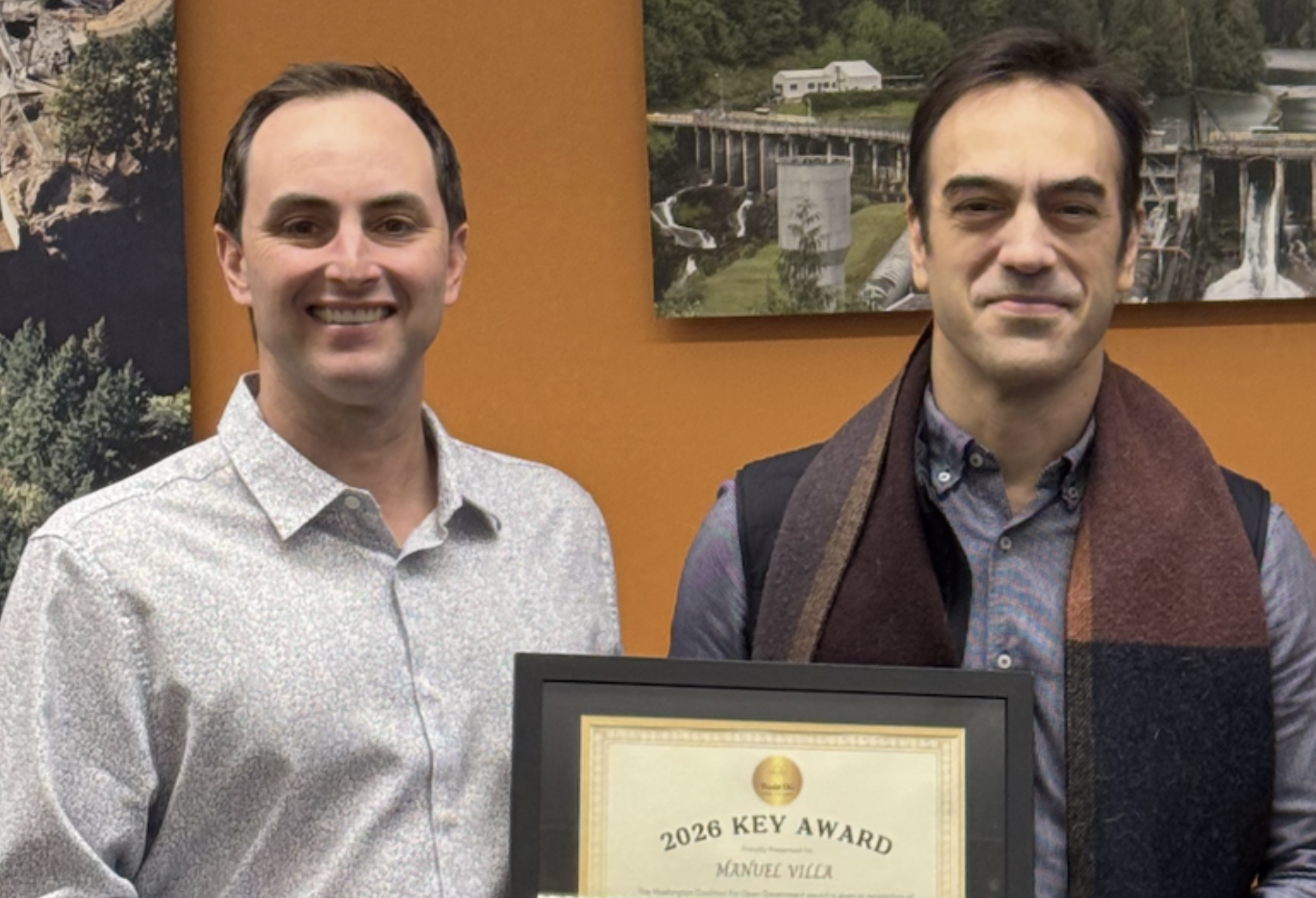
Seattle Times Deputy Investigations Editor Mike Reicher (left) stands with data journalist Manuel Villa on May 21 after Villa was presented the Washington Coalition for Open Government Key Award. (Photo by Mike Fancher)
Mike Reicher, deputy investigations editor at The Seattle Times, suggests people do some research into what records are available before requesting them. One complaint agencies often have is that requests are unclear or so broad that they will result in reams of material that the seeker might not actually want.
“The more (research) that you can do by looking at documentation online, even about databases that the government keeps or talking to people who work there, the more successful a request would be,” Reicher said.
The Washington Coalition for Open Government offers a great deal of information on public records requests and links to laws and resources; if questions remain, you can email info@washcog.org.
WashCOG wants individuals to exercise their rights to access and insist on transparency. Journalists cannot do the watching alone. It takes the power of the public to hold government accountable.
But it all starts with shining the light.
WashCOG is pleased to present a Key Award to Manuel Villa for his work and to extend accolades to the investigative team that helped him bring the pension issue back before the public. What the people do with that information remains to be seen.
In the meantime, WashCOG will keep working to protect the Public Records Act and Open Public Meetings Act. Individuals who make the effort to use those laws help keep them strong.